• Skip to primary navigation
  • Skip to main content
  • Skip to primary sidebar
  • About Us
  • Videos
    • Featured Video
    • Foodie Friday
    • Monthly ReCap
  • Online E-Editions
    • 2025
    • 2024
    • 2023
    • 2022
    • 2021
    • 2020
    • 2019
    • 2018
    • 2017
    • 2016
    • 2015
    • 2014
  • Social Media
    • Facebook
    • Twitter
    • Instagram
  • Advertising
  • Local Jobs
  • Puzzles & Games
  • Circulation Request

The Laker/Lutz News

Serving Pasco since 1981/Serving Lutz since 1964

  • Home
  • News
    • Land O’ Lakes
    • Lutz
    • Wesley Chapel/New Tampa
    • Zephyrhills/East Pasco
    • Business Digest
    • Senior Parks
    • Nature Notes
    • Featured Stories
    • Photos of the Week
    • Reasons To Smile
  • Sports
    • Land O’ Lakes
    • Lutz
    • Wesley Chapel/New Tampa
    • Zephyrhills and East Pasco
    • Check This Out
  • Education
  • Pets/Wildlife
  • Health
    • Health Events
    • Health News
  • What’s Happening
  • Sponsored Content
    • Closer Look
  • Homes
  • Obits
  • Public Notices
    • Browse Notices
    • Place Notices

Doug Sanders

Some things truly are priceless

July 11, 2018 By Doug Sanders

Remember finding a coin or arrowhead and wondering if it’s worth anything?

Imagine having a large document signed by Abraham Lincoln, passed down from one generation to the next, and not really knowing its value or its history with the nation’s 16th president.

For now, it has a safe and protected place in the home of 84-year-old Martha M. Fountain, a lifelong resident of Zephyrhills.
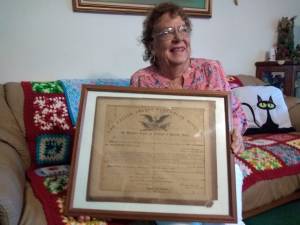
Dated December 15, 1864, Martha Fountain proudly holds ‘The President’s Thanks and Certificate of Honorable Service’ signed by Abraham Lincoln at the Executive Mansion in Washington City.
(Doug Sanders)

She lives in a community that was founded in 1909 by Capt. Howard B. Jeffries as a retirement colony for Union Civil War Veterans.

A newspaper man himself, Jeffries would not have missed the opportunity to write about Martha.

She has been the artifact’s owner since her husband’s death in 2016.

Married for 31 years to Guy Joseph Fountain Jr., Martha remembers the document hanging in her husband’s office of the Best Way Electric Company in Dade City.

“I’m not much into history,” Martha explained during a recent interview in her home, with her caregiver at her side. “I don’t know much about my husband’s family history,” she added.

Following six months of research with several military websites and The History Center at the Pioneer Florida Museum and Village north of Dade City, the remarkable life of the man named on the Lincoln document begins to emerge.

It turns out Guy Fountain had a great-great uncle named Samuel Warren Fountain.

He was only 15-years-old at the outbreak of the American Civil War on April 12, 1861.

Samuel had to wait until 1864 before joining an infantry of the 8th Corps of the Army of West Virginia, which became famous for having future U.S. presidents Rutherford B. Hayes and William McKinley serving in its ranks.

As part of the Valley Campaigns of 1864, Samuel Warren Fountain served under Maj. Gen. David Hunter during the Civil War. Hunter later achieved fame as the president of the military commission trying the conspirators involved with the assassination of President Abraham Lincoln.
(Robert Massey)

Samuel Fountain graduated from West Point on June 15, 1870, four months before the death of Confederate Gen. Robert E. Lee in Lexington, Virginia.

Commissioned a Second Lieutenant in the 8th U.S. Cavalry, he was active for the next 20 years in military campaigns against Geronimo and Sitting Bull.

He once described a skirmish in New Mexico as “rough country where horses cannot go.”

During the Spanish-American War, Samuel Fountain served first commanding a squadron of the 8th Cavalry in Cuba.

As Adjutant General in the Philippine Islands, a captain on his staff was John J. “Black Jack” Pershing, who later served as the commander of the American Expeditionary Force on the Western Front during World War I.

In 1904, when Fountain was a lieutenant colonel, he was put in charge of security at the St. Louis World’s Fair.

According to the Arlington National Cemetery website, a local newspaper reported this:

“Under his direction the members of the guard controlled the great mass of people…and on the last day of the Fair, when disorder and vandalism were feared, every officer and member of the guard was on duty, and so placed that when the lights were out and the World’s Fair at St. Louis had passed into history, not a disorderly act had occurred, or a dollar’s worth of property had been destroyed.”

Ironically, Geronimo was also at the fair as a living exhibit intended as a “monument to the progress of civilization.” Under guard, he made bows and arrows while Pueblo women seated beside him pounded corn and made pottery. Geronimo also sold autographs and posed for pictures.

President Abraham Lincoln’s signature remains legible after 154 years.
(Doug Sanders)

Samuel Fountain was a brigadier general a year before the Lincoln Memorial was dedicated in the nation’s capital. He gave a speech about Abraham Lincoln during his appearance before the Union League Club of Philadelphia on February 9, 1921:

“Other men have reunited a divided nation, or liberated an enslaved race, or carried to conclusion a fratricidal war, or swept immoral institutions from the earth by consummate Statesmanship; but no man ever combined and carried through, chiefly by the clarity of his mind and the purity of his character, several such gigantic enterprises in half a decade.”

Samuel Fountain died on Nov. 15, 1930, five months after the birth of Guy Fountain, and six years before the death of Capt. Howard Jeffries in New York City on March 20, 1936.

Martha Fountain recalls turning down an offer to sell the Lincoln document still in her possession.

But, with no children, she is undecided about its future.

At this point, she’s not sure what she will do with it. Before doing anything, she plans to consult her lawyer, John Council.

Council has had his own brush with preserving history, having a law office in Dade City at the historic red brick jailhouse, where the last legal hanging in Pasco County was carried out on Jan. 4, 1918.

Pasco’s early law enforcement days were notorious

October 11, 2017 By Doug Sanders

Pasco County’s early law enforcement days inspired quite a few dramatic stories.

An illegal killing captured headlines during Henry C. Griffin’s tenure as sheriff.

Built in 1892, the Old Pasco County Jail is the oldest brick structure in Dade City. It had two inmate cells, an isolation cell and an east wing used for the Sheriff’s living quarters. A later addition to the west end was the county’s gallows where the last legal hanging included “An array of picnickers positioned on the grounds surrounding the gallows area,” according to research conducted by local historian Madonna Jervis Wise in 2014. (Courtesy of Norman Carey)

During his second term, a mob killed two black men who were being held inside the county’s first jail located near downtown Dade City.

Will Wright and Sam Williams had been charged in the murders of Dan Childers and J.B. McNeil at Rice & Phelps’ turpentine camp near Dade City, according to newspaper stories published by The Tampa Morning Tribune.

The Tribune reported on Feb. 14, 1901, that Griffin refused to give up the keys and the mob —estimated as being between 30 to 50 men — broke down the outer door.

When they were unable to break down the steel doors of the cells, they opened fire, shooting both Wright and Williams to death, the report said.

The Coroner’s jury determined the prisoners came to their deaths at the hands of “parties unknown.”

Griffin lost his bid for re-election in 1904 to Bart Sturkie, who went on to serve four terms.

Another account of Pasco’s early law days involves the death of a Dade City farmer named Noah Green, who also is the Cherokee great-grandfather of Debbie DeLuca of Land O’ Lakes.

“As it stands right now, the only word I have on his death was the fire in the jailhouse,” DeLuca said.

“I have had cousins try to find his grave over in Linden Cemetery (off State Road 50 in Sumter County),” she added. “We were told it was in the center of the graveyard in an unmarked grave.”

Based on research for this column by Pasco County historian Jeff Miller, four newspapers including The Atlanta Constitution reported on the fire started by Green, who was “arrested on a charge of drunkenness and duly locked up.”

The 1892 cornerstone from the Old Pasco County Jail is currently on display at the West Pasco Historical Society in New Port Richey. (Courtesy of Fivay.org)

With a headline, “Cremates himself in lockup in Dade City,” The Tampa Morning Tribune printed this account on Nov. 23, 1911: “About 3 o’clock this morning, beginning to get sober, Green began to feel cold and scraping what rubbish he could gather on the floor, set fire to it.

“Locked up alone in the place, Green found it impossible to escape and began to cry loudly for help. No one was on the streets at that hour but a citizen who lives near the jail hurried to the place. He arrived too late, for Green was then beyond human aid. The jail was burned to the ground and Green’s charred and shrunken body was found in the ashes.”

Newspaper accounts are clear that Green left behind “a wife and five children,” but not much is known not about the wooden jail facility itself.

That incident offers just a glimpse into the county’s early law enforcement history, according to documents archived by fivay.org, a website that specializes in tracking Pasco County history.

Another vigilante mob stormed the jail in Dade City on the night of Aug. 5, 1915 and took a black inmate named Will Leak, according to the Dade City Banner. Leak had been charged with the attempted rape of a young white girl in Trilby and was hung on an oak tree in front of Hillard’s barber shop in the center of town. Details of the event were published on The Banner’s front page on Aug. 6, 1915.

Sturkie, who was serving his fourth term at the time of the break-in, was defeated in his re-election bid for sheriff in 1916 by Isaac Hudson, Jr., who served two terms as sheriff.

During his first six months in office, Hudson raided 164 moonshine stills, according to his son, Leon, who served as Dade City’s Police Chief in 1951.

Hudson’s family is prominent as the founders of Hudson, Florida.

Sheriff Hudson had a historic role on Dec. 28, 1917, when he released the trap door and executed Edgar London for the murder of his wife in the summer of 1917 at Ehren, near present-day Land O’ Lakes.

This is how the newspaper reported the last legal hanging in Pasco County, on Jan. 4, 1918: “The execution took place at ten minutes past one in the presence of a large crowd of whites and blacks who had come in for miles around to witness the affair.

“The negro was led to the platform by Sheriff Hudson and Deputy Osburn. He was accompanied by Rev. Father Francis (future Abbot at Saint Leo Abby), who had been with him all during the day, preparing him for his death. While the noose was being adjusted about his neck by Deputy Osburn, the negro displayed the utmost composure, never flinching once during the nerve-racking ordeal. He had the side of his face to the crowd and his lips could be seen moving in prayer.”

The account continued: “He never offered to say anything to the crowd, but kept his head well up and an erect position to the last, exhibiting a wonderful nerve. The black cap was placed over his head and the trap was sprung by Sheriff Hudson at 1:10. His neck was broken by the fall, and in six minutes he was pronounced dead by Dr. E. L. Reigle, the attending physician.”

Doug Sanders has a penchant for unearthing interesting stories about local history. His sleuthing skills have been developed through his experiences in newspaper and government work. If you have an idea for a future history column, contact Doug at .

Published Oct. 11, 2017

Dade City star had familiar face, but unfamiliar name

July 19, 2017 By Doug Sanders

Imagine this: A fictional round on the popular game show, “Jeopardy!”

The contestants listen closely as host Alex Trebek says:

“During the middle 1960s, he was one of the most recognizable faces on network television.”

A contestant responds: “Who is Roy Barnes Jones, of Dade City, Florida?”

Indeed.

Between takes on the set of Smoky in 1946, Roberts, center, finds time to get a haircut from his co-star, Fred MacMurray. Also starring Anne Baxter, Bruce Cabot, Hoyt Axton, Burl Ives and Slim Pickens, the movie was a drama about the strong bond between a cowpoke and a wild bronco set during the 1940s.
(Courtesy of the Scott Rollins Film and TV Trivia Blog)

Who is this man — whose face was familiar to millions, but whose name remains relatively unknown?

Roy Barnes Jones was born on March 18, 1906.

Records online with ancestry.com show that his parents were married in Dade City, and that his older sister, Nannie Louise Jones, was born there in 1904.

“It might be difficult to confirm that Roy was born in Dade City, but it seems likely,” according to Jeff Miller, webmaster for the Pasco County history website fivay.org.

“Some sources say he was born in Tampa, but maybe that’s because Tampa is better known,” Miller said.

He adds: “Roy’s father was a true Pasco pioneer, shown as living at Cedar Tree in 1870, before there was a Pasco County.”

While those same genealogical records document Jones as the youngest of six children in his family, not even the digital collections of the Dade City Banner— online at the University of Florida — make any mention of Jones’ 40-year career as a character actor. During those four decades, Jones appeared in more than 900 productions on stage and screen.

According to the Internet Broadway Database for theatre productions, Jones began his acting career on the stage as Roy Roberts, first appearing in such plays as “Old Man Murphy” in 1931, followed by “Twentieth Century” in 1932, “The Body Beautiful” in 1935 and “My Sister Eileen” in 1942.

“Roy was a cousin on the Tait side of my family and visited our home here in Dade City for family reunions when I was a kid,” recalls Darwin Croft, co-owner of Croft Farms in Pasco County.

Roy Roberts, with actors Don Knotts (Barney Fife) and Andy Griffith (Sheriff Andy Taylor) on the ‘Andy Griffith Show’ in 1962. In season 2 episode 29, Roberts played the vindictive newspaper publisher J. Howard Jackson, who accuses Sheriff Taylor of official misconduct after he is arrested on a traffic violation.

Additional sources from the Internet Movie Database report that Roberts made his motion picture debut in “Gold Bricks,” a 1936 two-reel comedy short released by the film studios at 20th Century Fox.

By 1943, he had successfully switched to the silver screen, debuting as a Marine officer in “Guadalcanal Diary” with William Bendix. He appeared in 1953 as the crooked business partner (and first victim) in Vincent Price’s “House of Wax.”

When he started recurring appearances on television, he was not known necessarily by name. But, the stocky character — portrayed with silvery hair and a perfectly trimmed mustache — reminded fans and actors of the “Mr. Monopoly” character from the classic board game.

“I remember being so thrilled that Roy was my distant cousin,” recalls Polly Hamm of Dade City.

Roberts made famous a take-charge demeanor when he played the no-nonsense Admiral Rogers on “McHale’s Navy” and the steely railroad president Norman Curtis on CBS’ “Petticoat Junction.”

The same thing could be said when he was cast as Darren Stephens’ father on “Bewitched” and as the father of Rob Petrie on the “Dick Van Dyke Show.”

As John Cushing, president of the Merchants Bank on CBS’s ‘The Beverly Hillbillies,’ Roberts, right, played the rival banker to Mr. Drysdale (Raymond Bailey), president of the Commerce Bank, which had Jed Clampett’s millions.

From 1956 to 1960, Roberts guest-starred in the western series, “My Friend Flicka,” which became the first television series filmed by 20th Century Fox, and as a Texas cattle baron in “The Life and Legend of Wyatt Earp.”

Roy Roberts appeared on four episodes of the CBS legal drama, “Perry Mason,” including the role of murderer Arthur Janeel in the 1961 episode, “The Case of the Malicious Mariner.”

In the 1963 comedy hit, “It’s a Mad, Mad, Mad, Mad World,” Blu-ray editions have restored Roberts’ small role as a police officer that was cut from the original film to reduce running time in movie theaters.

Roberts was the assured banker on both “Gunsmoke” and “Bonanza,” but perhaps one of his most familiar roles was as banker John Cushing in “The Beverly Hillbillies.”

Here’s an example of one his gruff reactions when dealing with the Clampett family, from the 1965 episode entitled “Clampett’s Millions”:

Jed Clampett: “Did you get our 45 million from Mr. Drysdale’s bank?”

John Cushing: “Every cent of it.  It’s all safe and sound, right in my bank.”

Jed Clampett: “That’s dandy.  We’d like to see it…in cash.”

John Cushing: (Exasperated) “I haven’t got it!?”

Jed Clampett:  Well, Granny?”

Daisy Moses: “Dogged, if he didn’t go through it quicker than Mr. Drysdale.”

Jed Clampett: “I think we’d be better off, back with him.”

In his last television appearance, Roberts played a veterinarian on the Jan. 21, 1974 CBS broadcast of “Here’s Lucy.”

Although he had a familiar face to viewers, he never had a leading role in Hollywood.

Roy Barnes Jones died of a heart attack in Los Angeles on May 28, 1975. He is buried with his wife Lillian Moore at Greenwood Memorial Park in Fort Worth, Texas. (Lillian Moore had her own film credits. She starred in the Stan Laurel and Oliver Hardy movies, “Sons of the Desert” and the “Devil’s Brother,” both produced by Hal Roach and released by the MGM studios in 1933.)

Doug Sanders has a penchant for unearthing interesting stories about local history. His sleuthing skills have been developed through his experiences in newspaper and government work. If you have an idea for a future history column, contact Doug at .

Published July 19, 2017

‘Cow Palace’ attracted music greats

May 24, 2017 By Doug Sanders

The block structure was built in 1957, without heat or air conditioning, according to records kept by the Pasco County Property Appraiser’s Office.

It was located in Carver Heights, a predominantly black neighborhood where many people lived hard-scrabble lives.

Scott Place, left, and Al Brown are hoping planned restorations can save the historic Cow Palace in Dade City. (Courtesy of the Chitlin’ Circuit Preservation Society)

And, during the next 20 years, the building attracted performers who would become some of the biggest names in soul-blues and R&B music.

Each of those musicians would travel down Bull Road — still a dirt lane southeast of Dade City. They would go past Ferguson Lake to make their way to the stage, inside the block structure.

It was a venue with a spacious dance floor and ornate Spanish-tiled bar.

And, that’s where bar-goers, who could get rowdy, had the chance to see performances by B.B. King or Ray Charles.

More often than not, people could hear the loud music outside as they passed the open pastures, as they did on the night that James Brown played.

Despite its remote location and wild weekends, this block structure became a juke joint variously known as “Rabbit’s Place,” “Jake’s Lakeside Tavern” and the “Cow Palace.”

It was part of the so-called “Chitlin’ Circuit,” which the National Public Radio defines as “a touring circuit that provided employment for hundreds of black musicians and brought about the birth of Rock ’n’ Roll.”

Glenn Thompson, secretary of the Pasco County Historical Society, said the circuit’s name “derives from the soul food item chitterling” which is made from stewed pig intestines.

Thompson is a big fan of the local Chitlin’ Circuit Preservation Society, co-founded by Scott Place, which is seeking funding to restore and save one of Florida’s historic blues clubs.

“We want to be like the Bradfordville Blues Club in Tallahassee,” Place said. That juke joint was shuttered for nearly 20 years before it reopened in the 1990s.

The dance floor and bar at the Cow Palace as it looked in April 2016.

Place also points to other success stories on the old Chitlin’ Circuit, such as the Jackson House in Tampa, the Manhattan Casino in St. Petersburg and the Cotton Club in Gainesville.

Place, a Dade City blues musician who performs under the name “Howlin’ Buzz,” hopes future generations will have a chance to know more about the Cow Palace and its historic links to stars like King, a relatively unknown artist who brought a Chitlin’ Circuit tour to the Cow Palace in the late 1950s.

Buddy Guy played at the Cow Palace early in his career and was later inducted into the Rock and Roll Hall of Fame by Eric Clapton and B.B. King on March 14, 2005.

Writing on his Facebook page, Guy said: “The tone (B.B. King) got out of that guitar, the way he shook his left wrist, the way he squeezed the strings…Man, he came out with that, and it was all new to the whole guitar-playin’ world.”

The Cow Palace attracted stars and fans to a very poor neighborhood.

“There was nothing like that anywhere in Tampa Bay,” recalled George Romagnoli, in a news report published 25 years ago.

First subdivided in 1946 by Stanley Cochrane, the subdivision where the Cow Palace sits likely was named after the renowned botanist George Washington Carver, according to Bill Dayton, a member and former chairman of the Dade City Historic Preservation Advisory Board.

“Maybe he had an admiration for Carver,” Dayton told The St. Petersburg Times in 1998.  “Or maybe he just thought it was an appropriate name for a black subdivision,” Dayton added.

No regularly hosted events have been held at the Cow Palace since the mid-1970s, but a jam session there two years ago drew approximately 100 musicians and guests.

“We found out there was no commercial zoning, and that’s what we need for live entertainment in the future,” Place said.

Even with rezoning issues and the challenges of restoration, Place believes people would stand in line to enter the Cow Palace as they did 50 years ago.

“They would admit as many people as possible (back then). But, there was only one way in — or out,” Place said, with a smile.

To find out more about the Cow Palace and efforts to restore it, email .

Doug Sanders has a penchant for unearthing interesting stories about local history. His sleuthing skills have been developed through his experiences in newspaper and government work. If you have an idea for a future history column, contact Doug at .

Published May 24, 2017

Larkin’s legacy goes beyond ‘tough guy’ reputation

March 22, 2017 By Doug Sanders

William M. Larkin’s reputation for being a tough character outlasted his lifetime.

Known as “The Meanest Man in Pasco County,” some people still recall that moniker applied to the Dade City man, nearly a half century after his death in 1973.

William M. Larkin is photographed on his land that was later donated to the Pioneer Florida Museum and Village.
(Courtesy of Rabun L. Battle Collection)

Larkin reinforced that image by keeping a single-shot .22 rifle in the gun rack of his truck — a statement that often left a lasting impression with young cowboys.

“Someone once wrote a letter to him, but they didn’t know his address,” said Bobby Tesar, recalling Larkin’s legendary reputation. “So, they addressed the letter to “The Meanest Man in Pasco County”—and he got the letter!”

But, Larkin is known around Pasco County for much more than being considered a man with a difficult disposition.

During his lifetime, he was a cattleman and lawyer, a member of the Pasco County School Board and the chairman of the Southwest Florida Water Management District.

He established the first Santa Gertrudis herd in Florida in the early 1940s.

“He gave the first bull “Rex” water and hay while penned in his side yard on Church Avenue,” said Ray Battle, who is Larkin’s cousin.

Larkin transported Rex from Texas, in a trailer he pulled with his own car.

Larkin’s neighbors soon would learn all about Rex and about Pancho, a 6-foot tall sire brought to Dade City from the world-famous King Ranch in south Texas. That ranch, founded in 1853, now stretches into six Texas counties, encompassing 825,000 acres.

U.S. 98 split the Larkin Ranch after its construction in the early 1950s, but it still has two cattle underpasses, similar to the one pictured here. William M. Larkin came up with the idea, to herd his cattle from Polk County to Pasco County.
(Courtesy of Doug Sanders)

The Larkins made frequent trips to King Ranch, to expand their cattle herd in Pasco County.

In 1940, the United States Department of Agriculture recognized what Larkin already knew: Santa Gertrudis was a distinctive beef breed, adaptable to most climates.

“A Santa Gertrudis female can remain in production well past her 12th birthday and may stay in the breeding herd as long as 18 years,” reports the current Santa Gertrudis Breeders International website.

Gaining additional calves over other cattlemen in Pasco County was perhaps a key reason that Larkin began searching for more land.

Another primary reason was the success of his law practice that he operated along with his brother, E. B. Larkin.

This painting of ‘Pancho,’ the Larkin’s most prolific Santa Gertrudis bull, hung for many years at the Crest Restaurant in downtown Dade City.
(Courtesy of Doug Sanders)

Larkin’s law practice enabled him to begin extensive land buying, including acreage along the Withlacoochee and Hillsborough rivers, Battle said.

“He also had his eye on some rich land north of Dade City, which he got from 41 different property owners,” Battle added.

With hundreds of acres along County Road 35-A (Old Lakeland Highway) and the Atlantic Coastline Railroad, Larkin would complain that the exit to his ranch was blocked whenever the train was parked there for long periods of time.

At breakfast one morning at the Crest Restaurant, Larkin told Charles Edwards that the train had pulled away that day with nearly half of the cars left behind.

“He said that he disconnected them!” Edwards recalled.

“I asked him about it a few months later, and he said they hadn’t parked there again,” Edwards added.

Larkin used the railroad to his advantage when unloading large bulldozers at the depot to help begin constructing levees on that rich land north of Dade City.

Draining the swampy marshes with high hammocks into improved pasture “required a dragline and expensive labor,” Battle explained.

Purchased in 1924, the Larkin home on Church Avenue was originally built as a three-room cottage in 1884. It was part of a 10-acre spread that was later platted as one of the first subdivisions in Dade City.
(Courtesy of Doug Sanders)

Larkin also brought seven pumps with 28-inch propellers from South Florida to discharge water into what became the Duck Lake Canal.

The canal remains a major drainage system, along with the Larkin Canal, for the greater Dade City area and that rich land still known as “The Little Everglades Ranch.”

Larkin was responsible for drafting the fence law for the Florida Legislature, and because of its 1949 passage, Florida remains a ”closed range” state — making cattle drives through the state’s towns and cities a thing of the past.

To abide by the ruling and to keep cattle on his own land, Larkin fenced 15,000 acres, stretching from north Dade City to south of the Polk County line.

So in addition to his reputation for being difficult, Larkin was known for quite a few accomplishments.

Plus, not everyone believed he was mean.

Kitty Register Fisher recalls the time when her father was in the hospital and her mother had just lost a baby.

“We were getting really low on food, and Mr.  Larkin showed up with food to help us.

“To my family he was a good man,” Fisher said.

Could it be — that beneath that tough exterior — William M. Larkin, of Dade City, was actually a nice guy?

Doug Sanders has a penchant for unearthing interesting stories about local history. His sleuthing skills have been developed through his experiences in newspaper and government work. If you have an idea for a future history column, contact Doug at .

Published March 22, 2017

Mock battle presents live history lesson

December 14, 2016 By Doug Sanders

Nearly 200 re-enactors from all over Florida take part in the mock battle that’s held every year.

With about 1,500 spectators watching from a hillside, the re-enacted battle  takes place a few hundred feet from the actual battleground inside the Dade Battle Historic State Park in Sumter County.

Frank Laumer stands outside his hand-built home in Hernando County. He lives about 15 miles from the Dade Battlefield Historic State Park in Sumter County, where he first took his family for a picnic in 1962. Laumer has written three books about the history of Dade’s Massacre. The library in his home also serves as the headquarters for the Seminole Wars Foundation.
(Doug Sanders/Photos)

The real battle, that took place 181 years ago, started the Second Seminole War.

That war would last seven years, cost $40 million in historic dollars, and claim the lives of 1,500 U.S. soldiers.

Two months after what would come to be known as “Dade’s Massacre,” Gen. Edmund Gaines and 1,100 of his men would be the first U.S. soldiers to find the site that was still scattered with the remains of dead bodies, with buzzards circling overhead.

An eyewitness account by Seminole leader Halpatter Tustenuggee (Alligator, as the white man called him) later described how it all began:

“Micanopy fired the first rifle, the signal agreed upon, when every Indian arose and fired, which laid upon the ground, dead, more than half the white men.”

Dade’s Massacre is often overshadowed by other battles of the 19th century, including the fall of the Alamo in 1836 and Custer’s Last Stand in 1876, but it has been the subject of three books by local historian Frank Laumer.

Francis Langhorne Dade was born in King George County, Virginia.

He enlisted in the Army in 1813, and was elevated to major in 1828.

On the morning of Dec. 23, 1835, Laumer says Major Dade departed from Fort Brooke (currently the site of the Tampa Convention Center in downtown Tampa) to lead his men through 100 miles of wilderness and open territory.

Reconstructed log breastworks stand where Major Dade’s men fought a losing battle with Seminole Indian warriors on a cold December afternoon. The artillery blasts from Dade’s cannon had halted the fighting in the morning, giving soldiers enough time to build the original fortifications in 1835. Archaeologists have found piles of flattened rifle balls at the site that is now part of the 80-acre Dade Battlefield State Park in Bushnell.

As an officer of the 4th Infantry, he was to reinforce the troops at Fort King (present-day Ocala), who were being threatened by the Seminole Indian Chief Osceola.

They would have to cross four rivers and slowly pull a 6-pounder cannon with a team of horses.

After five days on the rugged Fort King Road, Dade told his men, “Have a good heart,” based on historical records of the massacre.

Laumer is certain that Dade felt the most dangerous part of their journey was behind them once they had reached present-day Bushnell.

Dade had told his men: “As soon as we arrive at Fort King, you’ll have three days to rest and keep Christmas gaily.”

But, Seminole scouts in the scrub forest had followed the long column of 108 men under the command of Dade.

As Laumer points out, Dade was an easy target while riding in front of his men.

While crouching at the edge of the piney woods, Seminole Chief Micanopy had plenty of time to aim his rifle at the chest of Major Dade.

Dade was 42 when he became the first casualty in Dade’s Massacre.

His heart was pierced by a bullet fired by Chief Micanopy.

Laumer writes: “Francis Dade, broad shoulders erect, slumped gently in his saddle like a bag of grain cut in the middle.”

The Seminoles clearly had the element of surprise, Laumer writes. Only a few of Dade’s men managed to get their flintlock muskets from beneath their heavy winter coats in order to return fire.

“The cannon was discharged several times, but the men who loaded it were shot down as soon as the smoke cleared away…,” Alligator later reported.

Dade’s soldiers, dressed in blue wool uniforms, found themselves fighting against a fierce band of 180 Seminole warriors camouflaged in brown shirts or tunics, with winter leggings for warmth.

By the end of the day, just three U.S. soldiers remained alive.

Major Dade and his command would have travelled this section of the old Fort King Road — that is about 20 feet wide. It is still maintained at the Dade Battlefield State Park in Sumter County.

News of the massacre was reported in the Daily National Intelligencer up north in Washington D.C.

A report in the Jan. 27, 1836 edition noted “…three soldiers, horribly mangled, came into camp, and brought the melancholy tidings that Major Dade, and every officer and man, except themselves, were murdered and terribly mangled.”

President Andrew Jackson called for volunteers from Florida, Georgia, Alabama and South Carolina. He also ordered Gen. Winfield Scott to assume command of all U.S. forces in the area.

The Seminoles fighters who had won a major victory that day, left the battlefield after carrying off weapons from the soldiers they had killed.

After spending more than half of his life researching and writing about Dade’s Massacre, Laumer will narrate the annual re-enactment on Jan. 7.

It’s a familiar role for him, as he’s carried it out for more than 30 years.

Although the first Seminole War had been fought to remove Indian tribes west of the Mississippi River, there was always growing political pressure to send more troops to fight in Florida.

Laumer points out the frustration on the part of Southern plantation owners who were tired of their slaves escaping to Florida and granted refuge by the Seminole Indians.

He also explains that the outcome of Dade’s Massacre helped the white man to settle and develop Florida.

With more than 30,000 soldiers fighting in the longest and costliest Indian conflict in American history, many stayed in Florida after the Second Seminole War to raise their families on free land –so long as they were prepared to defend themselves from further Indian attacks.

A total of 1,317 land grants, with approximately 210,720 acres, were registered between 1842 and 1843.

While the massacre has largely faded from public memory, Dade is the namesake for several places. They include Miami-Dade County, Dade County, Georgia; Dade County, Missouri; Dadeville, Alabama; and, of course, Dade City, Florida.

There also is a decommissioned fort in Egmont Key State Park in Hillsborough County that is named after Dade.

Doug Sanders has a penchant for unearthing interesting stories about local history. His sleuthing skills have been developed through his experiences in newspaper and government work. If you have an idea for a future history column, contact Doug at .

Tracing the development of early Lutz

November 9, 2016 By Doug Sanders

Once one of the most active stops for wood-burning locomotives, Lutz was settled with just a handful of homesteaders.

William Paul Lutz was a railroad engineer. He and his brother, Charles, played a pivotal role in the history of Lutz, a community north of Tampa. (Photographs courtesy of Susan A. MacManus)
William Paul Lutz was a railroad engineer. He and his brother, Charles, played a pivotal role in the history of Lutz, a community north of Tampa.
(Photographs courtesy of Susan A. MacManus)

There was a store and a couple of houses there in 1907, and once the Tampa Northern Railroad was extended from Brooksville to Tampa that same year, the Concord Stagecoach Line went out of business.

But, that news didn’t discourage two brothers from West Virginia — William Paul Lutz and Charles Henry Lutz.

That’s because one of the largest sawmills in northwest Hillsborough County was the Gulf Pine Lumber Company — which was south of Odessa and owned by Charles Lutz.

In 1909, Charles Lutz built a tram track to carry his lumber 10 miles to the east, connecting his sawmill to the Tampa Northern Railroad at what is now Lutz Lake Fern Road and U.S. 41.

William Lutz — Charles’ brother — was the railroad engineer.

Most of the area was “nothin’ but sand,” according to the recollections of Dorothy Lutz Jones, stepdaughter of William Lutz.

“Then from there on to Tampa, there was nothin’ until you got there, down to the city,” Jones is quoted in an account published by local historian Susan A. MacManus, a professor at the University of South Florida.

First Lutz United Brethren Church was built in 1914. Before that, church members met at Lutz School.

MacManus and her mother, Elizabeth Riegler MacManus, wrote “Citrus, Sawmills, Critters and Crackers: Life in Early Lutz and Central Pasco County.

William Lutz is reported to have witnessed “strange events” as he engineered his train through such a remote countryside.

“It was not uncommon to come across public hangings and to see some unfortunate soul with his neck still in the noose,” the local history book notes.

According to his wife’s journal, William Lutz sold cars on the side and would take orders for a vehicle, and then strike one on the tracks with his locomotive.

“The railroad would pay for the damaged car, Lutz would buy it, have it repaired, and then sell it to his customer,” according to a published account.

William Lutz exhibited a better side of his nature to the family of Ella McDowell in December 1912. Ella had received a handwritten note thrown from the train by Lutz inviting her to ride with him to Tarpon Springs and spend Christmas with his family.

Trains like these helped pave the way to Florida’s future. (Courtesy of Tampa Bay History Center)
Trains like these helped pave the way to Florida’s future.
(Courtesy of Tampa Bay History Center)

The year — 1912 — was also a memorable year for the local residents demanding their own post office.

That was largely because the investors of the North Tampa Land Company.

C.E. Thomas, the company’s president, had been busy marketing “…a vast settlement where folks could buy tracts of land to farm and raise orange groves,” according to the MacManus’ book.

Thomas would eventually build the new post office, and donate land for the wood-frame schoolhouse, cemetery and church. He even provided jobs with his nursery.

But, when postal officials named the new post office “Lutz” on March 27, 1912, they helped cement the memory of the contributions of the two Lutz brothers, in an area still generally known today as North Tampa.

Doug Sanders has a penchant for unearthing interesting stories about local history. His sleuthing skills have been developed through his experiences in newspaper and government work. If you have an idea for a future history column, contact Doug at .

Published November 9, 2016


A citrus king who savored the art of the deal

September 14, 2016 By Doug Sanders

When James Emmitt Evans was 12 years old, he already knew what he wanted to do.

He aimed to be “a general business man,” as he liked to call it.

By the time he died, at age 96, the Dade City man would have gone on to build one of the first citrus concentrate plants in the state south of Dade City.

This is where Evans Packing Plant stood in February 1989. (Courtesy of Pam Higgins/The History Center/Pioneer Florida Museum and Village Collection)
This is where Evans Packing Plant stood in February 1989.
(Courtesy of Pam Higgins/The History Center/Pioneer Florida Museum and Village Collection)

He is perhaps best remembered for his pioneering strategies to hedge juice inventory on the futures market, and for planting some of the largest contiguous citrus groves in Florida.

When he died, his obituary carried the lead headline on the front page of the June 13, 1996 edition of The Tampa Tribune.

A half-century before his death, Evans was a vice president on the board of the Pasco Packing Company in Dade City. Other board members were L. C. Edwards Jr., president (whose father was the former head of the Florida Citrus Exchange); W. F. Edwards, vice president (namesake of the football stadium at Pasco High School in Dade City); L.C. Hawes, vice president; and, H.S. Massey, secretary-treasurer.

These men, who were all citrus growers, had a combined total of 10,000 acres that could produce 2.5 million boxes of fruit annually for processing at the plant.

When the company’s whistle was heard across Dade City at noontime, the Valencia Restaurant in downtown Dade City was often the unofficial “Board Room” for Pasco’s board of directors.

Located across from the Historic Pasco County Courthouse at the time, the Valencia was probably the place where plans were discussed to sell the company to Lykes Brothers in Tampa.

With the citrus industry changing beyond all recognition, Pasco’s board members recognized how frozen concentrate was letting growers preserve and ship juice with greater efficiency.

Built in 1900, the longtime residence of James Emmitt Evans is now the home of a Pasco County Circuit Court judge. (Courtesy of Doug Sanders)
Built in 1900, the longtime residence of James Emmitt Evans is now the home of a Pasco County Circuit Court judge.
(Courtesy of Doug Sanders)

Only 50,000 gallons of concentrate were produced in the inaugural year of 1945. By 1951, production had zoomed to 31 million gallons.

Selling the plant allowed the new owners to change the name to Lykes Pasco Packing in 1961, and to market its labels around the world as “Old South,” “FloridaGold” and “Vitality.”  At its peak, Lykes had more than 2,000 workers on its payroll in Dade City.

Unlike any grower in the state at the time, Evans was a trader with his own accounts on the emerging Frozen Concentrate Orange Juice futures market.   He was never satisfied with dealing through brokers, buying his own seat and remaining a major force during the formative years of the exchange.

“All I can say is, I love making deals,” Evans said, in a Feb. 2, 1983 story published by The Gainesville Sun.

Evans Packing Company was one of the first processors to supply other packagers with drums of bulk concentrate for distribution to chain stores.  At its peak with some 400 employees, many of Evans’ six grandchildren and five great-grandchildren worked side-by-side with their spouses and in-laws.

“If they’re kin, we’ll give them a job,” he was quoted as saying.

Evans enjoyed spending time with his family and friends.

He employed his own pilot, Sam Fallin, who flew the eight-seat, twin engine King Air to the Evans ranch in Homestead, where friends and family could spend a weekend fishing, playing golf, and hunting.

Over the years, Evans endured his share of challenges.

His citrus groves faced hard freezes, the Mediterranean fruit fly and citrus canker.

The area where Evans Packing Plant stood is vacant today, except for the Walgreens at the intersection of U.S. 301 and Morningside Drive. (Courtesy of Doug Sanders)
The area where Evans Packing Plant stood is vacant today, except for the Walgreens at the intersection of U.S. 301 and Morningside Drive.
(Courtesy of Doug Sanders)

Despite these harsh realities, Evans started the development of 7,000 acres for production in St. Lucie County in the 1960s. He also began an even larger grove along the Indian River/Okeechobee County lines near the Florida Turnpike during the 1970s. And, the purchase of 10,000 acres for additional groves in Charlotte County was completed in the early 1980s.

Evans did not live to see the outbreak of citrus greening, the agricultural disease with no known cure that has decimated Florida’s citrus production to an all-time industry low.

The 1983 Gainesville Sun story identified Evans as one of 21 Floridians on the Forbes magazine list of the 400 wealthiest Americans. At the time, he citrus fortune was estimated at $135 million.

Five years later, he was the oldest resident in Florida on Forbes 400 list, with $400 million in holdings — putting him at 157th place on the list.

Evans had been successful since the early 1920s, starting off with less than $500 from selling tractors.

“I never did have a bad year in business,” he told The Gainesville Sun. “Not even during the Great Depression.”

Despite his wealth and success, Evans lived in the same wood frame, three-bedroom home on the corner of 12th Street and Meridian Avenue in Dade City for 49 years.

He headed his family business for 39 years.

And, the company he founded in 1951 still remains as one of the largest growers in the state with 12,000 acres of citrus groves.

“Retirement is not for me,” Evans was quoted in 1983.  “Retirement is the day I die.”

It turns out, that’s exactly what happened.

Doug Sanders has a penchant for unearthing interesting stories about local history. His sleuthing skills have been developed through his experiences in newspaper and government work. If you have an idea for a future history column, contact Doug at .

Published September 14, 2016

Nobody seems to know for sure if Coolidge visited Dade City

August 10, 2016 By Doug Sanders

About a year ago, my first history column for The Laker/Lutz News posed the question: “Did President Calvin Coolidge have lunch in Dade City?”

Since that column published, on Aug. 19, 2015, new information has surfaced that keeps the question open.

Edward Bok and his wife, Mary Louise, are shown here with President Calvin Coolidge and his wife, Grace, on Feb. 1, 1929, the day that Coolidge spoke at the dedication ceremony at Bok Tower Gardens in Lake Wales. (Courtesy of Bok Tower Gardens)
Edward Bok and his wife, Mary Louise, are shown here with President Calvin Coolidge and his wife, Grace, on Feb. 1, 1929, the day that Coolidge spoke at the dedication ceremony at Bok Tower Gardens in Lake Wales.
(Courtesy of Bok Tower Gardens)

At the July meeting of the Pasco County Historical Society, I reminded those gathered that Dade City didn’t appear to offer much back in 1929, when Coolidge was said to have stopped there for lunch.

There’s no doubt President Coolidge was in Florida that year, because he gave a speech at the dedication ceremony for Bok Tower Gardens in Lake Wales.

It’s possible he could have stopped at the Edwinola in Dade City, if he took a detour and came to the area on the Seaboard Airline Railroad.

The Edwinola opened as a hotel in 1912. There, Coolidge could have enjoyed the tea dances held with an orchestra at one end of the large porch.

But, the Valencia Restaurant was not open for business. Neither was the Crest Restaurant.

Lunch on Limoges would not serve its famous pecan chicken until 1981.

And, A Matter of Taste restaurant did not open until 1997.

So why does rumor have it that he lunched at the Gray Moss Inn?

This photograph is believed to be from the dedication day of Bok Tower Gardens on Feb. 1, 1929. (Courtesy of Bok Tower Gardens)
This photograph is believed to be from the dedication day of Bok Tower Gardens on Feb. 1, 1929.
(Courtesy of Bok Tower Gardens)

Supposedly, there was a connection between Coolidge and the owners of the Gray Moss Inn. However, I was never able to confirm that lead.

After my first column was published, though, I heard from Susan Maesen, of Dade City.

She wrote: “Mr. Sanders, I am sorry I didn’t have the opportunity to give you information concerning this article.”

As the daughter of Jack Dudley, Susan has memories of her family running the Gray Moss Inn after the death of her grandmother.

“There were ledgers that each guest had to sign in,” she wrote. “I cannot verify that Coolidge signed a ledger. I can verify my dad telling me that he visited.”

In last year’s column, I indicated there were unconfirmed “tips” that the old guest registry wound up in the hands of Dr. R. D. Sistrunk, who lived a few blocks down the street across from the First Baptist Church.

Now, I know from Susan, that Dr. Sistrunk was her grandfather on her mother’s side.

Legend has it that President Calvin Coolidge ate lunch at the Gray Moss Inn in Dade City, but no documentation has yet been found to verify that. (Courtesy of Helene Eck Sparkman Collection)
Legend has it that President Calvin Coolidge ate lunch at the Gray Moss Inn in Dade City, but no documentation has yet been found to verify that.
(Courtesy of Helene Eck Sparkman Collection)

But, did the Pasco County Historical Society know that Coolidge’s train may have stopped briefly in the early morning hours at Trilby?

Dade City Commissioner Scott Black, who grew up in Trilby, said he was told by the late Clifford Couey, that no one got off the train when it stopped in Trilby, before it departed from there traveling on the Orange Belt Railway en route to St. Petersburg.

I was unable to independently confirm that Coolidge’s train did stop in Trilby. But a year later, it can be documented that Coolidge appeared at the Vinoy Park Hotel, in St. Petersburg, on Jan. 24, 1930.

After my original column on Coolidge was published, Daniel Wright, of Citrus Springs,  wrote: “Perhaps something new will turn up in a private collection that will confirm it one way or the other.”

That is still a real possibility.

So, please, look through your closets and check your attics. If you can find evidence that Coolidge visited Dade City in 1929, I’d love to see it and to share it with readers of this column, which is published regularly in The Laker/Lutz News.

Doug Sanders has a penchant for unearthing interesting stories about local history. His sleuthing skills have been developed through his experiences in newspaper and government work. If you have an idea for a future history column, contact Doug at .

Published August 10, 2016

Thrasher’s impacts felt, from Atlanta to Dade City

June 29, 2016 By Doug Sanders

While he doesn’t have the name recognition of other famed railroad builders, John James Thrasher played a role in bringing the first railroad to Dade City, thus helping to develop the future county seat of Pasco County.

Little is known about his life before he reached the age of 21.

He was born on Feb. 14, 1818, as the second oldest in a family of 14 children.

From left, John J. Thrasher, George W. Collier and George W. Adair. (Courtesy of The Atlanta History Center)
From left, John J. Thrasher, George W. Collier and George W. Adair.
(Courtesy of The Atlanta History Center)

He would go on to be credited for his efforts to rebuild Atlanta after the American Civil War, and would become a prominent citizen of Georgia.

During a family reunion earlier this summer at the Pioneer Florida Museum and Village in Dade City, David Sumner described Thrasher as “a railroad builder, entrepreneur, merchant and politician.”

Sumner is the great-great grandson of Thrasher, and a 1964 graduate of Pasco High School.

Thrasher — known as “Cousin John” to his many friends and family — was hired in 1839 to do work on the terminus of the Western and Atlantic Railroad in an area near present-day downtown Atlanta.

The Georgia General Assembly had authorized the railroad construction project as a northward link to Chattanooga and the Midwest.

In early 1861, Thrasher was Fulton County’s state representative when Georgia joined the Confederate States of America.

Major battles against Union armies would take place at Chickamauga in 1863, and Kennesaw Mountain in 1864.

When Union troops under the command of William Tecumseh Sherman drew near during the Atlanta campaign, much of the population had fled the city, including Thrasher, his wife, and four sons and three daughters.

This rapid exodus reduced Atlanta’s population from around 22,000 to less than 3,000.

John J. Thrasher lived the last 15 years of his life in Dade City and is buried next to his wife, Bethuel Scaife Thrasher. According to records of the Dade City Cemetery, there are 25 family descendants also interred here. (Doug Sanders/Photo)
John J. Thrasher lived the last 15 years of his life in Dade City and is buried next to his wife, Bethuel Scaife Thrasher. According to records of the Dade City Cemetery, there are 25 family descendants also interred here.
(Doug Sanders/Photo)

On Sept. 2, 1864, James M. Calhoun, the 16th Mayor of Atlanta, surrendered to Sherman, writing, “Sir: The fortune of war has placed Atlanta in your hands.”

Union soldiers occupied Atlanta for the next two months and burned most of it to the ground on Nov. 15, 1864.

In an article published by The Pasco News in 1999, Sumner described Thrasher at 46 years of age with no possessions left in a city that was “a burned waste of destruction.”

The elegant Thrasher home on Ashby Street had been the headquarters of Confederate Gen. John B. Hood. The Atlanta Constitution reported that Union troops did not destroy it, but they carried off the marble mantels, melted the outside ornamental ironwork and converted the library into a blacksmith’s shop.

After the war, Thrasher was one of 12 charter members of the Atlanta Street Railway Company — formed to operate the city’s first streetcars in 1866 according to the Atlanta History Center.

As Atlanta’s first merchant on Marietta Street, a state historical marker currently designates the site as “Thrasherville—Where Atlanta Began,” Sumner says.

He explains that Thrasher “physically and economically laid the foundations for modern-day Atlanta.”

According to the Thrasher Family papers at Emory University and the University of Georgia, Thrasher helped to build a school and supervised the construction of the new Fulton County Jail in 1865.

“The building is neither gorgeous nor picturesque,” reported the Atlanta Intelligencer, “but it is substantial, and it will answer its purpose.”

Within four years, Georgia became the last Confederate state restored to the Union.

It was during this period that Thrasher moved north of Atlanta along the Richmond and Danville Railroad, and founded a town he named after a good friend, Jonathan Norcross, who was the fourth mayor of Atlanta.

In the 1880s, Thrasher and his wife followed two of their sons to Dade City.

The elder Thrasher planted orange trees, while one son, David, became county judge in 1887, the third superintendent of schools in 1896, and was elected mayor of Dade City on Feb. 6, 1905.

Spending the rest of his life in Dade City, the elder Thrasher gave speeches and was instrumental in bringing the first railroad to town.

In 1885, the Florida Southern Railroad (later a part of the Atlantic Coast Line Railroad) was built 40 feet from the present-day Dade City Cemetery, heading toward Lakeland.

This would transform the town’s economic growth.

The existing Atlantic Coast Line Depot along the U.S 98 Bypass is one of four historic depots that have served the local area.

In October 1887—23 years after Sherman set fire to Atlanta—President Grover Cleveland addressed a crowd of approximately 50,000 people attending the Piedmont Exposition.

As a showcase for the city’s reconstruction since the Civil War, The Atlanta Constitution reported that “Cousin John J. Thrasher” was at the exposition “as one of the best known and most popular men who ever lived in Atlanta.”

He died in Dade City on Nov. 14, 1899, when he was 81. In part, his obituary read: “…and now his death carries away next to the last of the three famous pioneers who were here before any of the people making this their home had ever heard of the place.”

Adding to the family legacy is Robert Woodruff, a great-grandson of Caroline Thrasher, who herself was a first cousin of (John J.) Thrasher.

Woodruff was an influential head of the Coca-Cola Company for nearly 60 years and a famous Atlanta philanthropist.

“I have spent the last 20 years researching the life of John Thrasher,” Sumner recalled during the family reunion in Dade City. “More than his accomplishments, I am touched by his character—his love, generosity, and kindness toward others. That’s why everyone called him ‘Cousin John.’”

Demand to Evacuate Atlanta
“Now you must go, and take with you the old and feeble, feed and nurse them, and build for them, in more quiet places, proper habitations to shield them against the weather until the mad passions of men cool down, and allow the Union and peace once more to settle over your old homes in Atlanta.” — William T. Sherman

Source: “Memoirs of General William T. Sherman” (Second Edition; New York. D. Appleton and Company, 1904).

Doug Sanders has a penchant for unearthing interesting stories about local history. His sleuthing skills have been developed through his experiences in newspaper and government work. If you have an idea for a future history column, contact Doug at .

Published June 29, 2016

  • « Go to Previous Page
  • Page 1
  • Page 2
  • Page 3
  • Page 4
  • Go to Next Page »

Primary Sidebar

Search

Sponsored Content

All-in-one dental implant center

June 3, 2024 By advert

  … [Read More...] about All-in-one dental implant center

WAVE Wellness Center — Tampa Bay’s Most Advanced Upper Cervical Spinal Care

April 8, 2024 By Mary Rathman

Tampa Bay welcomes WAVE Wellness Center, a state-of-the-art spinal care clinic founded by Dr. Ryan LaChance. WAVE … [Read More...] about WAVE Wellness Center — Tampa Bay’s Most Advanced Upper Cervical Spinal Care

More Posts from this Category

Archives


Where to pick up The Laker and Lutz News

Copyright © 2025 Community News Publications Inc.

   